|
||
24. Regmaglypts |
| Return to Contents |
| Back...Next |
| Regmaglypts on Iron and Stone meteorites |
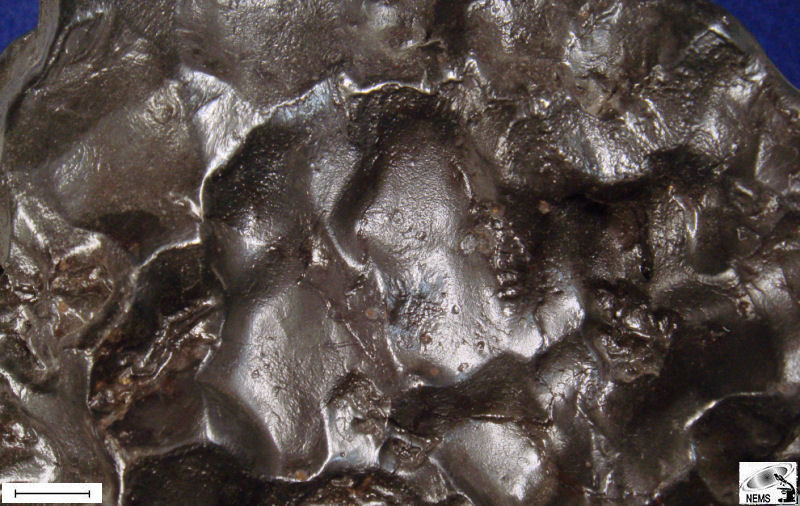 |
Figure 1. Scale bar 1.5 cm. |
| Meteorite, Sikhote-Alin, Iron, IIAB |
| ________________________________________________________________________________________________________________________ |
| Regmaglypts on
Meteorites Figure 1. Regmaglypts on the Sikhote-Alin iron meteorite (IIAB). Scale bar=1.5 cm. Figure 2. Regmaglypts on the Gibeon iron meteorite (IVA). Scale bar=1.5 cm. Figure 3. Regmaglypts on the Pultusk stone meteorite (H5 chondrite). Scale bar=0.8 cm. Figure 4. Regmaglypts on the Sikhote-Alin iron meteorite (IIAB). Scale bar=0.9 cm. Formation and Characteristics Regmaglypts (from Greek rhegma, “fracture,” and glyptos, “carved”) are distinctive thumbprint-like depressions or pits sculpted into the surface of meteorites. They are most prominently developed on iron meteorites but can also occur, though typically less pronounced, on stony meteorites. These features are aerodynamic ablation sculptures formed during the meteoroid’s high-velocity atmospheric entry. As a meteoroid enters Earth’s atmosphere at cosmic velocities (typically 11–72 km/s), it encounters intense ram pressure and frictional heating. Compression of air ahead of the object generates a shock wave and a glowing plasma sheath, with surface temperatures reaching ~1,650°C (3,000°F) or higher. This causes rapid melting and ablation (erosive removal) of surface material, while turbulent airflow shapes the remaining melt layer, producing the characteristic regmaglypt topography. The process ceases during “dark flight” once the object decelerates to terminal velocity. Role of Mineralogy The development of regmaglypts is influenced by the meteorite’s composition and the differential ablation of its mineral phases. In iron meteorites, the primary constituents are: • Kamacite (~1,500°C melting point) • Taenite (30–40% Ni; ~1,460–1,470°C) • Cohenite (iron carbide; ~1,400°C) • Schreibersite (iron-nickel phosphide; ~1,000°C) • Troilite (iron sulfide; ~990°C) Lower-melting-point phases such as troilite and schreibersite ablate preferentially, enhancing pit formation. Graphite (sublimation point ~3,600°C) plays a negligible role. In stony meteorites, regmaglypts form through ablation of the silicate matrix and fusion crust development, often appearing shallower due to different thermal properties. Influencing Factors Regmaglypt morphology depends on multiple variables: • Entry velocity and angle • Duration of atmospheric heating • Meteoroid size, shape, and orientation (tumbling produces more irregular patterns). • Ablation rate and melt viscosity Oriented meteorites often show more symmetric regmaglypts on the leading face, while fragmented or tumbling individuals exhibit complex, overlapping patterns. Significance Regmaglypts serve as diagnostic indicators of atmospheric entry and provide data on entry dynamics, fragmentation history, and pre-atmospheric shape. They are particularly well-preserved on fresh falls such as Sikhote-Alin (1947) and help distinguish genuine meteorites from terrestrial pseudometeorites (e.g., industrial slag or iron concretions). Comparative studies across chemical groups (e.g., IIAB vs. IVA irons) reveal insights into material response under extreme conditions. |
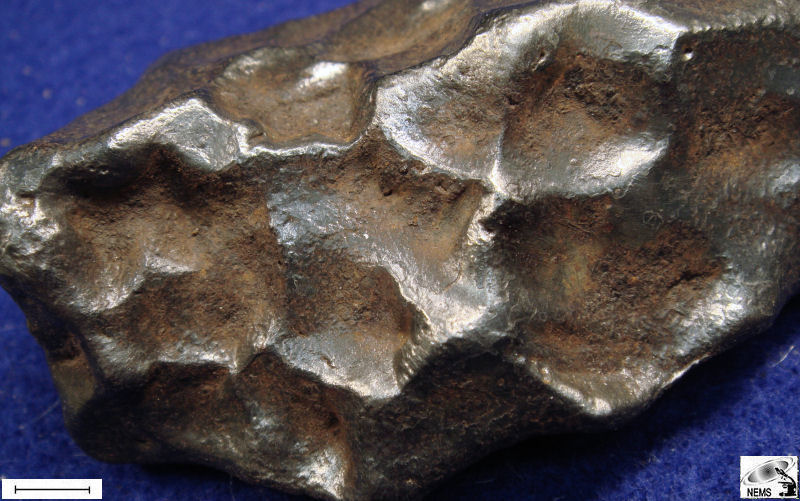
Figure 2. Scale bar 1.5 cm. |
| Meteorite, Gibeon, Iron, IVA |
| Regmaglypts |
| _________________________________________________________________________________________________________________________ |
| |
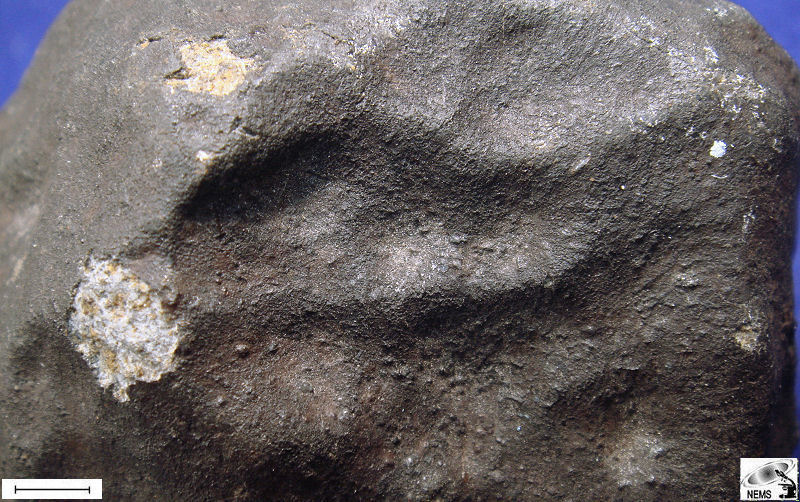
Figure 3. Scale bar 0.8 cm. |
| Meteorite, Pultusk, Stone, H5 chondrite |
| Regmaglypts |
| __________________________________________________________________________________________________________________________ |
| |
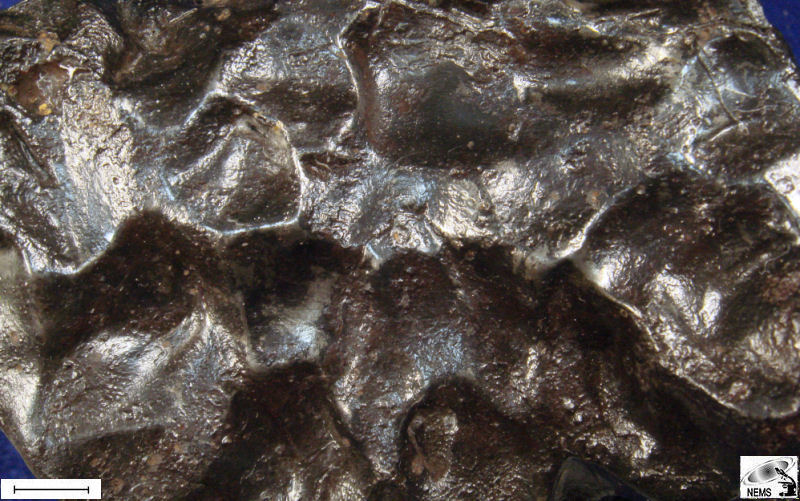
Figure 4. Scale bar 0.9 cm. |
| Meteorite, Sikhote-Alin, IIAB, Iron, IIAB |
| Regmaglypts |
| ___________________________________________________________________________________________________________________________ |
| |
| References • Buchwald, V. F. (1975). Handbook of Iron Meteorites. University of California Press. (Detailed discussion of atmospheric passage and surface features.) • Rubin, A. E., & Ma, C. (2021). Meteorite Mineralogy. Cambridge University Press. (Context on ablation and mineral behavior during entry.) • General literature on meteorite aerodynamics and regmaglypts (e.g., papers in Meteoritics & Planetary Science). |
| Return to Contents |